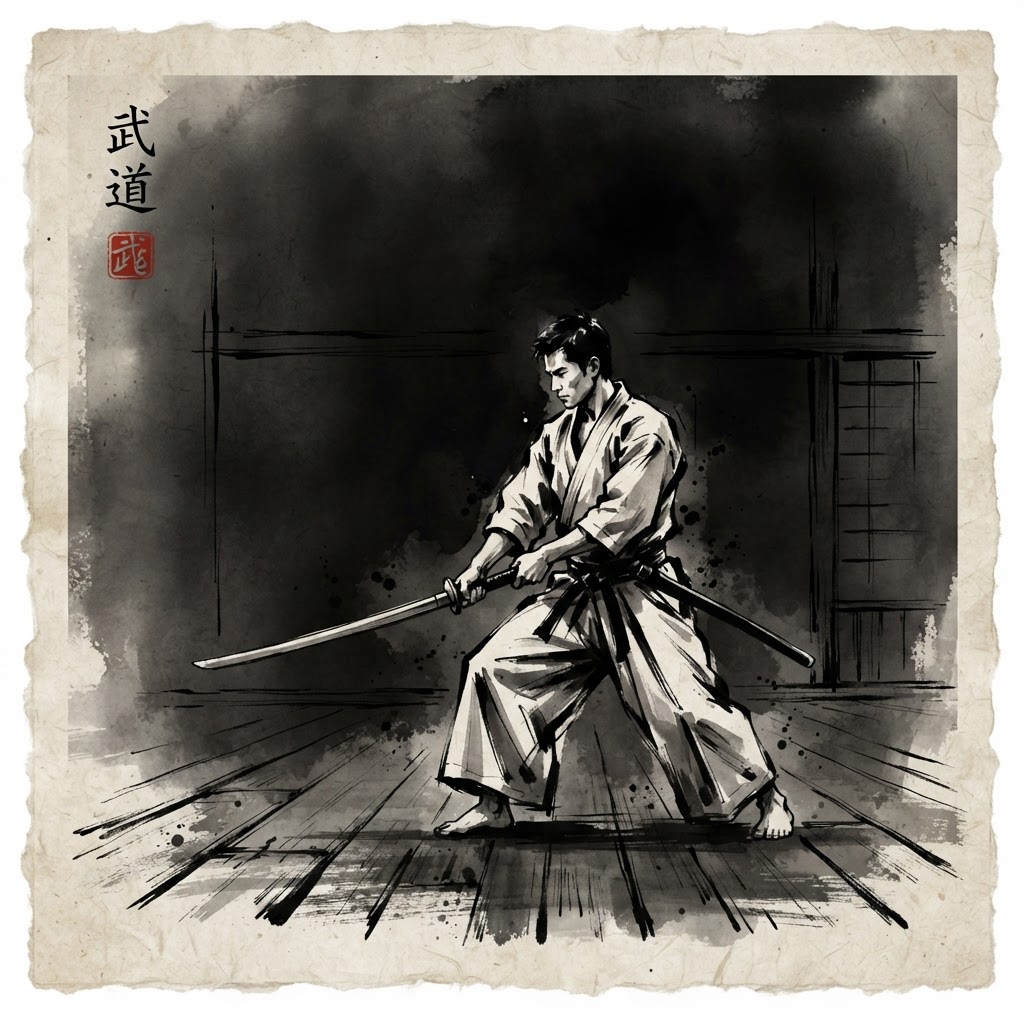
What is Japanese Budo?
What is Japanese Budo?
Walk into any traditional dojo and you will eventually hear the word budo (武道). It appears on walls, embroidered on bags, spoken with a certain weight. But what does it actually mean? And why does a word that translates simply as "the way of war" carry so much more than a fighting spirit?
From Battlefield to Way of Life
Budo is often described as the modern evolution of Japan's older bujutsu (武術) — the practical fighting techniques of the samurai. Bujutsu was developed for the battlefield: techniques tested in conflict, refined for survival. Sword drawing, joint locking, grappling, striking — these were tools of a professional warrior class.
As peace came to Japan under the Tokugawa era, and especially after the samurai class dissolved in the Meiji period, the purpose of these arts shifted. Techniques designed to kill on a battlefield began to be practiced for something else entirely: the refinement of the human being. This transformation is the heart of budo. The character do (道) means "way" or "path" — a lifelong journey rather than a destination.
So where bujutsu asks "does this technique work?", budo asks a deeper question: what kind of person does the practice of this technique make me?
The Dojo as a Place of Awakening
The word dojo literally means "place of the way." It is not a gym. You do not merely attend a dojo; you train in one. This distinction matters, because in budo the training hall itself is considered sacred space — a laboratory where you confront yourself through physical practice.
Every bow at the door, every fold of the gi, every repetition of a technique is deliberate. These rituals are not empty formalities. They are the structure that allows a student to leave ego at the entrance and practice with full presence. Over time, the discipline of the dojo begins to follow you out of the dojo.
The Difference Between Fighting and Training
Many people come to martial arts wanting to learn to fight. That is an honest motivation, and budo takes the practical seriously — techniques must remain functional. But a student who trains long enough discovers something unexpected: the greatest opponent on the mat is not the person across from you. It is your own fear, impatience, anger, and self-deception.
This is why budo traditions speak of shin gi tai (心技体) — spirit, technique, and body. True skill requires all three developed together. A fighter with technique but no composure breaks under pressure. A student with spirit but no technique is just enthusiasm. Budo is the discipline of bringing these into harmony.
Why Budo Still Matters Today
You will probably never fight a sword-wielding samurai. So why train?
Because the same presence that keeps you calm under pressure in the dojo keeps you calm in a difficult conversation, a high-stakes moment at work, or an emergency. Because the humility of being a beginner — over and over, for years — builds a patience nothing else does. Because the body keeps score: posture, breathing, awareness, and confidence are all trained on the mat.
Budo, practiced honestly, is simply the slow, lifelong project of becoming someone worth being — using physical practice as the chisel.
Our Lineage
At Tatsujin Dojo, we practice two classical Japanese traditions: Bujinkan Budo Taijutsu, descended from the ninja and samurai schools of old Iga and Koka, and Daito-ryu Aiki Jujutsu, the ancient aiki tradition of the Takeda clan. Both are living examples of this evolution — battlefield arts preserved as paths of self-cultivation, passed from teacher to student for generations.
We would be honored to walk part of that path with you.
If this resonates with you, apply to train — we take a small number of dedicated students each season.