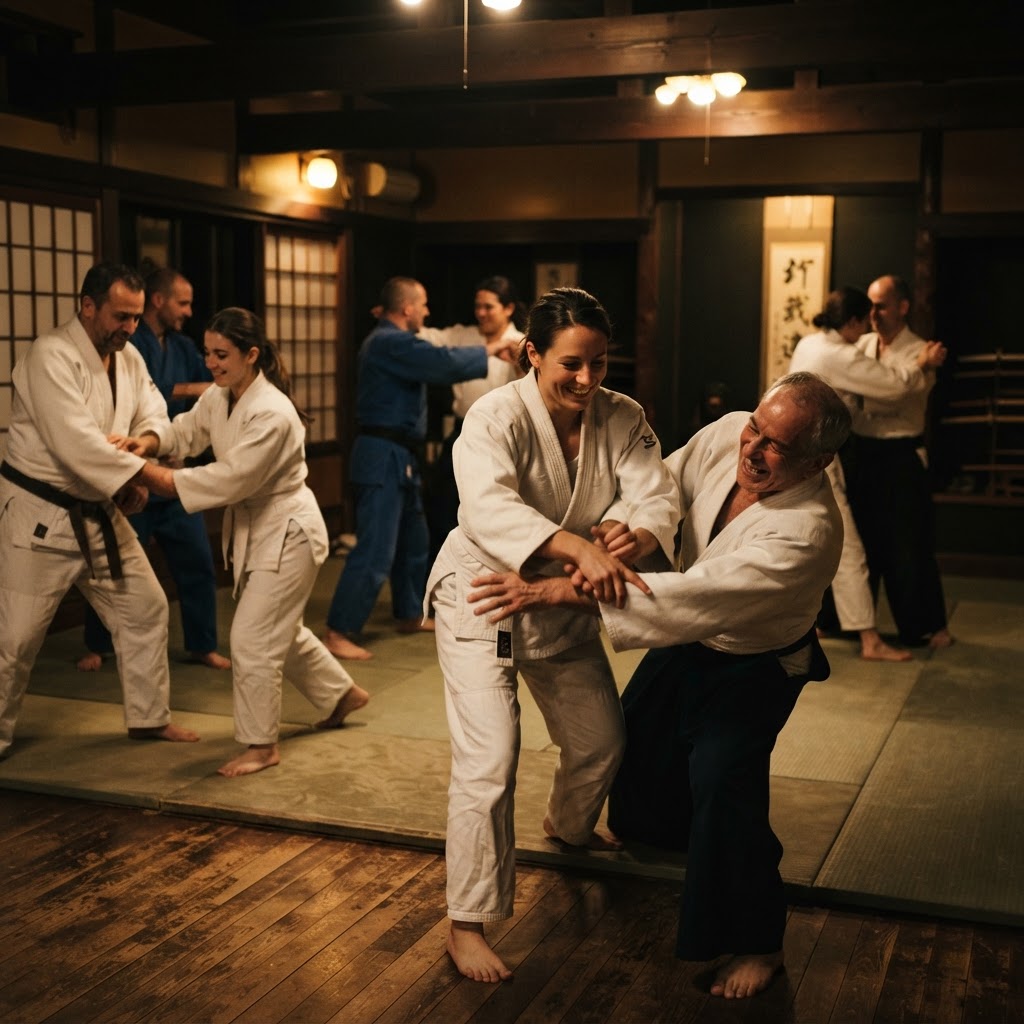
Why Train in the Martial Arts as an Adult
"Am I too old to start?" If I had a dollar for every time someone asked me that at the dojo door, I could retire. The short answer: no — and not in a polite, encouraging, well-meaning way. In an honest, this-is-actually-true way. Some of our most dedicated students started in their 40s, 50s, and beyond, and the classical Japanese arts we teach were never designed for young athletes in the first place.
If you've been telling yourself that martial arts is something you missed your window on, this post is for you.
Kids' Class Logic Doesn't Apply to Adults
Most people's mental image of martial arts training comes from children's programs: high kicks, loud kiai, belt tests, and tournaments. That's a modern, commercialized version of arts that are, in our case, centuries old.
Bujinkan Ninjutsu and Daito Ryu Aikijujutsu are koryu-derived arts — traditions preserved from Japan's warrior era, when techniques had to work for a samurai at 25 and a veteran strategist at 55. Nothing about them depends on youthful flexibility or explosive athleticism. They depend on balance, structure, timing, and sensitivity — qualities that adults often learn faster than kids, because they come from attention, not tendons.
This is why a 55-year-old with no martial arts background can make genuine, satisfying progress in these arts. Not "progress for their age." Real progress.
What Adults Actually Get From Training
1. A body that works better
We don't market fitness, but fitness arrives anyway. Junan taiso — traditional Japanese mobility work — restores range of motion most adults lost a decade ago. Falls and rolls make your hips, knees, and back more resilient. Nobody at the dojo counts reps; everyone quietly gets stronger, looser, and more capable.
2. Genuine stress relief
The mat is one of the few places your phone isn't. For two or three hours a week, your only concern is the technique in front of you — a rare, complete form of presence. Adults consistently tell me the drive home after class is the calmest their mind gets all week.
3. Practical, proportionate self-defense
Classical arts teach control: off-balancing, joint locks, escape and disengage. They scale naturally to real adult situations — including the situations adults actually worry about — without requiring you to out-punch anyone.
4. A community of adults
Tatsujin Dojo students are professionals, artists, parents, engineers, and veterans. Training together twice a week for years builds friendships that gyms never do — there's a particular trust in people you've practiced falling with.
5. The long-game hobby your brain is craving
This might be the deepest benefit. Most adult hobbies plateau: you learn to ski, you get as good as you're going to get, the novelty fades. Classical martial arts deepen instead — decades in, you're still discovering new layers in a technique you thought you'd mastered. That endless frontier is what keeps 30-year practitioners showing up.
The Things That Hold Adults Back (Answered)
"I'm not flexible / strong / fit." Neither art requires it to start. Technique replaces strength; range of motion returns gradually with training. Start now, and let fitness catch up to you.
"I'll look foolish." Our beginner culture is real. Everyone remembers their own terrible first class. Nobody watches beginners with judgment — they watch them with memory.
"I don't have time." Two classes a week, and we'd rather you come once consistently than three times sporadically. You likely spend more time than that on scrolling.
"I tried a class once somewhere and it wasn't for me." Every dojo has its own culture and lineage — that's like deciding you don't like food because of one bad restaurant. Come try ours before writing off arts with 400+ years of history.
The Only Real Barrier
Here's what I tell every adult who asks whether it's too late: the only thing age changes is how long you've been thinking about it. The techniques don't care whether you're 28 or 58. The mat doesn't care. Your training partners don't care.
Five years from now you'll be five years older regardless. The only question is whether you'll also be five years into something worth doing.
Your first class is free — no gear, no commitment, no experience needed. Book it here, and come find out what the mat has been waiting to give you.