Bujinkan vs. Daito Ryu: Which Art Is Right for You?
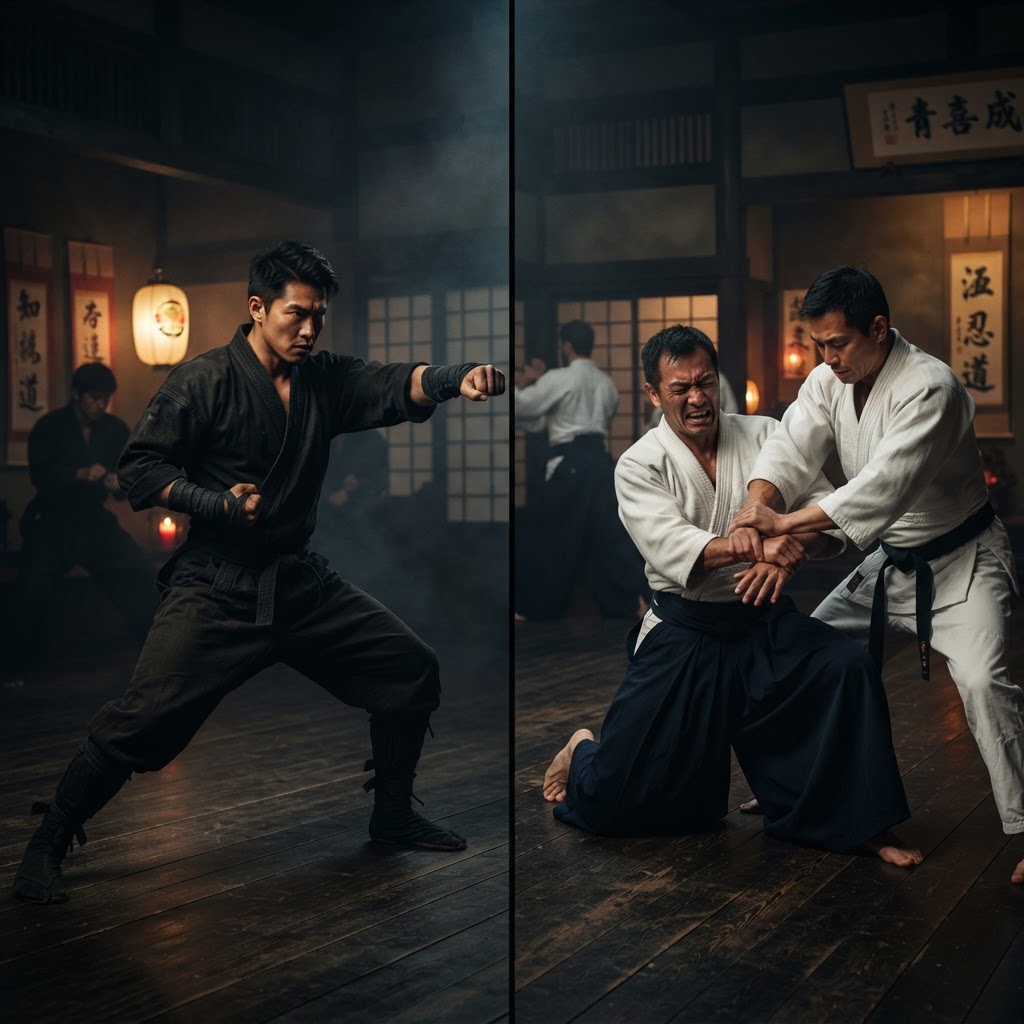
"Which art should I try?" It's the question I hear most from people walking into Tatsujin Dojo for the first time — and it's a genuinely good one. Tatsujin Dojo is unusual in New York: we teach two classical Japanese traditions side by side, Bujinkan Ninjutsu and Daito Ryu Aikijujutsu. They come from the same country, the same warrior culture, and the same core insight — that structure beats strength — yet they feel completely different on the mat.
There's no wrong answer here, but there is a right-for-you answer. Here's an honest breakdown of both arts to help you find yours.
Bujinkan Ninjutsu: The Art of Adaptability
The Bujinkan preserves the teachings of nine historical Japanese schools (ryuha), unified under Soke Masaaki Hatsumi. Its foundation is Taijutsu — natural, whole-body movement that doesn't rely on strength or athletic ability.
What training feels like: varied. One class might focus on unarmed striking and throwing; the next on staff, sword, or knife work; the next on escaping grabs, ground positions, or multiple attackers. Bujinkan teaches you to flow between ranges — standing, clinched, on the ground — and to improvise when a technique breaks down.
What draws people to it:
- It's a complete system — striking, grappling, and traditional weapons under one roof
- The philosophy of adaptability appeals to people who don't want rigid, sport-style rules
- Weapons training connects you to Japanese martial history in a hands-on way
- It's famously beginner-friendly: natural movement means no pre-required strength or flexibility
Who it tends to fit: curious generalists. If you want breadth — a little of everything, woven into one coherent art — and you're drawn to the unconventional, Bujinkan will feel like home.
Daito Ryu Aikijujutsu: The Art of the Samurai
Daito Ryu is one of the oldest jujutsu traditions in Japan — the root art that later gave rise to aikido. Practiced by the samurai elite of the Aizu clan, it specializes in aiki: refined joint locks, off-balancing, and the subtle manipulation of an attacker's structure that the Japanese call internal power.
What training feels like: precise. Techniques are practiced slowly and exactly, with deep attention to angles, balance, and connection. Over time the softness becomes the point — a skilled practitioner controls an attacker with what looks like almost no effort at all.
What draws people to it:
- Deep technical precision — a craft you can refine for decades
- The elegance of aiki: defeating force with structure rather than opposition
- A direct, unbroken link to samurai-era close-quarters combat
- A meditative, detail-oriented practice that develops patience and sensitivity
Who it tends to fit: patient craftspeople. If you love detail, precision, and the idea of studying one deep thing for a long time, Daito Ryu will reward you endlessly.
The Honest Comparison
| | Bujinkan Ninjutsu | Daito Ryu Aikijujutsu | |---|---|---| | Character | Flowing, adaptive, complete | Precise, structural, refined | | Curriculum | Unarmed + weapons, multiple schools | Close-quarter grappling, aiki principle | | Pace of training | Varied, responsive | Slow, exact, deep | | Physical demand | Moderate, scalable to any level | Low-impact, technique-driven | | Best for | Generalists who want breadth | Specialists who want depth |
Both arts share the same DNA: neither depends on size, strength, or age. A 130-pound student and a 230-pound student train together productively in both — that's not a marketing claim, it's how classical Japanese arts were designed.
The Answer Most People Don't Expect
Here's the thing: you don't have to choose before you start. Both arts share so much underlying principle — balance, distance, timing, structure — that the first months of either one will improve the other. Plenty of our students train both. Plenty try one, fall in love, and never look back.
My honest advice: come to a free class, try the art you're leaning toward, and pay attention to how you feel walking out the door. Do you want more of that? Then you've found your answer.
Try both free — book your trial class and just tell us you'd like to sample each. Friday evenings and Sunday afternoons in Industry City, Brooklyn. We look forward to training with you.